
There is really little new that can be said about Beijing's air pollution, so I am generally reluctant to write about it. Nevertheless, I feel the last couple of days merit special notice. It has been bad. It has been bad in a way that the word "bad" just doesn't capture. The simple phrase "bad air", despite its elegance, leaves far too much open to interpretation. This is not unusual. Regular readers may recall that last June I had to invent the word "nastulous" [nast-yuh-luhs] to describe a particularly grim stretch of atmosphere because no existing vocabulary seemed to do it justice.
Again, however, I find that reality has outstripped even my dictionary-shattering lexicon, so I am forced to resort to metaphor.
How bad was the air the last two days? If it was a person it would have been a seedy, broad-shouldered thug, dressed in filthy leathers and reeking of grain alcohol, last-night's whorehouse and cheap cigarettes, that hauled you into an alley by your collar and beat you senseless with a lead pipe wrapped in duct tape, emptied your wallet, found your grandmother's address inside, went to her house and beat her senseless with the same pipe, cleared out her jewelry box and sodomized her golden-retriever on the way out the door before setting fire to her cottage, coming back to the alley and kicking you in the ribs one more time for good measure.
It was that bad. And even that may not quite capture the sheer evil of it.
The night before last I went to the gym to run on the treadmill but I could see the grunge in the air inside the gym swirling in cones under the spotlights. The idea of pulling any more of it through my lungs than absolutely necessary was appalling. I could achieve the same results by cutting my lungs out of my chest, rubbing them up and down on the street until they picked up a good coating of diesel soot, coal ash and cigarette butts, and then sewing them back in. So I gave up on the idea and went home to watch television instead, confident that it represented a net health gain.
Showing posts with label Beijing. Show all posts
Showing posts with label Beijing. Show all posts
Saturday, December 29, 2007
News from the soon-to-be-not-home front
The below is from Imagethief's China blog this week. I'm glad I'm not there.

Monday, December 3, 2007
Pandas and jackhammers

I don't have much to say about this, but I thought it was interesting.
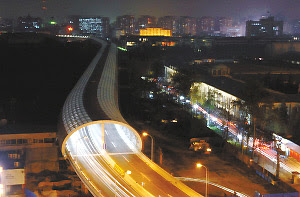
The city of Beijing just opened an elevated tunnel. The goal is to ease traffic that snarls up as cars try to move between the West second and third ring road. This sounds perfectly normal, and much like the bypass any other city might build.
The difference is that this tunnel passes over the Beijing City Zoo, and it's supposedly soundproofed to protect the animals. I haven't been to the zoo. Scot hasn't been to this one, either, but he says that zoos in China are the most appalling he's seen. This particular zoo is home to China's premier panda exhibit, however, so I hope that the high profile keeps them honest. I'm curious whether the efforts to soundproof the tunnel will pay off, but I wonder more about what the animals went through while they were building the damn thing.
Sunday, December 2, 2007
Visitors from the land past the setting sun
Daria and Christian visited recently. Daria was here to see me, and Christian was in town trying to renew his visa. We crammed into the apartment for a few days, and got some good touristing in. I've let too much time pass to get into detailing what all we did, but I posted pictures.
There's the new Strangeness page, a page for our trip to the 798 Art District in a vacated weapons factory, two separate pages for stuff Daria and I saw, and one for when Daria and Christian were both around.
There's the new Strangeness page, a page for our trip to the 798 Art District in a vacated weapons factory, two separate pages for stuff Daria and I saw, and one for when Daria and Christian were both around.
Friday, November 30, 2007
Living the dream
It's taken me a while, but I've increasingly come to a simple conclusion- I hate China. I'm willing to accept that I may just hate Beijing, since in reality I haven't spent much time in other parts of the country, but I definitely hate something.
Let me start with the Beijing-specific.
Who builds a megacity, a seat of power over an exploding (I'll not say booming) economy, here? It's perched on the edge of the world's biggest desert. It's not at the mouth of a navigable river, or on a strategic port. It's far enough North that the winters are brutal, made worse by the complete lack of moisture to retain heat at night. It's in a valley that traps pollution, so when the sky isn't sleet-grey it's tinged with the browns and yellows of poisons.
The accent in Beijing is jarring. Spoken Chinese can hardly be described as a beautiful language, at least to our Western sensibilities, but even in China the Beijing accent is considered the worst. Imagine, if you will, taxi drivers who are incapable of understanding "Park the car in Harvard Yard", and need the proper accent applied to the sentence for a glimmer of recognition to flutter in their alcohol-shot eyes. Beijing-hua is best spoken with a nasal whine, with a liberal application of Rs to the ends of words.
There is disturbing poverty within a literal stone's-throw of the Great Hall of the People. I'll post pictures of the slums South of Tiananmen soon, but they're truly decrepit. This a block from the black-tinted windows of the black Audis with black government plates.
I live in a rich neighborhood, surrounded by expats and the wealthiest Chinese. Not 30 minutes ago I was in Jenny Lou's, a grocery store that caters to foreigners with its imported goods. The faceless and absent Mrs. Lou is a despicable bitch, however, and would gladly gut your children for an extra dollar's profit. Nevertheless, the place has a monopoly on Triscuits and Macaroni, so we foreign devils pay our king's ransom and smile as she twists the knife. I did not, you'll note, restrictively refer to myself and my foreign colleagues as 'capitalist running dogs' or 'capitalist roaders'. I think it should be clear why. I can understand why foreigners, far from home, would fork over wads of cash for longed-for luxuries. I cannot, however, understand why Chinese locals will pay the same obscene markups for vegetables, fruit, and meats that are no different from those at the Chinese grocer down the street. Watching the Chinese couple in front of me pay $150 for a grocery bill (an astronomic sum nearly equal to a month's salary for your average white-collar Beijing worker), I saw no other option but to dump my loose change into the cups of the beggars outside the store.
The spitting. I have no way of describing it for those of you who haven't visited. There are 3 sounds I'm unable to escape: construction, horns, and HAAAGHH. It's not polite spitting, it's lung-clearing, projectile expulsions. Sometimes a gentleman in a suit will stop on the sidewalk, plug one nostril with a finger, close his mouth, and exhale sharply.
If you're not dodging phlegm, you're dodging cigarette butts (still lit), taxi bumpers, and bicyclists on cell phones.
Beer is expensive and disgusting. Daria and I had drinks at my coworker James's place last weekend, and I felt great the next morning. I'd gotten used to Chinese hangovers, caused by impure alcohol with all its formaldehyde and God knows what. Drinking imported Western liquor, even in quantities, is healthy by comparison. Tsingtao has almost no flavor, no bubbles, no color, and no alcohol. Besides a mild, soapy aftertaste, what's the point? I'm simply unable to drink Chinese liquor. Some pansy-ass Chinese gentleman informed me it was because Western men weren't 'used to' such strong alcohol (the Chinese is more like 'capable of being used to'). I responded by pulling out a hip flask of scotch and inviting him to try what Western men drank. That's another thing- the cultural elitism. China is great, grand, and flawless. I understand that they're restricted in their exposure to media, but the logical disconnect between wanting to be like us and thinking that they're already far superior to us is sort of mind-boggling.
Environmental bombardment. The air hurts, the people make me sick, the noise is penetrating. When I went to Thailand, what amazed me the most was the skies. I'd honestly forgotten that sky was so blue and that clouds were so fluffy. Isn't that depressing?
I go on about the little things that I hate about living here, and it really is little things that build up to make it intolerable, but the worst is that I don't know what's good about this place- I just can't find it. The food can be good. There are occasionally things that are cool, like the red stars on granite, but then I realize that they're cool because they're symbols for things that are blessedly-absent at home.
I've had fun on some of the days when I've been a tourist. There are breathtakingly beautiful buildings and parks here, you just have to seek them out. The problem is that they're not integrated into the city. It's not like Central Park, or the Common, where you just walk through as you get out of the subway on your way to work. To get into the Summer Palace, or even pedestrian Chaoyang Park, you have to pay an entry fee and fight through the throngs of tourists. There is great beauty here, but it's all labeled as such and priced accordingly.
All of this, plus a lack of job satisfaction, an absence of good friends, and steadily declining weight (and health?) combine to make me strongly consider moving back home in the spring. I'm still weighing options, and I think I've found a good English teaching gig here, but I don't know whether the investment of time and mental health will pay off in terms of Chinese learned and resulting career benefits. As much as I was eager to get out of Boston, I think about it rather fondly from here. So besides looking at teaching jobs here I'm looking at lab positions in NYC, Boston, and San Francisco. I don't know how I'll make the eventual decision.
Let me start with the Beijing-specific.
Who builds a megacity, a seat of power over an exploding (I'll not say booming) economy, here? It's perched on the edge of the world's biggest desert. It's not at the mouth of a navigable river, or on a strategic port. It's far enough North that the winters are brutal, made worse by the complete lack of moisture to retain heat at night. It's in a valley that traps pollution, so when the sky isn't sleet-grey it's tinged with the browns and yellows of poisons.
The accent in Beijing is jarring. Spoken Chinese can hardly be described as a beautiful language, at least to our Western sensibilities, but even in China the Beijing accent is considered the worst. Imagine, if you will, taxi drivers who are incapable of understanding "Park the car in Harvard Yard", and need the proper accent applied to the sentence for a glimmer of recognition to flutter in their alcohol-shot eyes. Beijing-hua is best spoken with a nasal whine, with a liberal application of Rs to the ends of words.
There is disturbing poverty within a literal stone's-throw of the Great Hall of the People. I'll post pictures of the slums South of Tiananmen soon, but they're truly decrepit. This a block from the black-tinted windows of the black Audis with black government plates.
I live in a rich neighborhood, surrounded by expats and the wealthiest Chinese. Not 30 minutes ago I was in Jenny Lou's, a grocery store that caters to foreigners with its imported goods. The faceless and absent Mrs. Lou is a despicable bitch, however, and would gladly gut your children for an extra dollar's profit. Nevertheless, the place has a monopoly on Triscuits and Macaroni, so we foreign devils pay our king's ransom and smile as she twists the knife. I did not, you'll note, restrictively refer to myself and my foreign colleagues as 'capitalist running dogs' or 'capitalist roaders'. I think it should be clear why. I can understand why foreigners, far from home, would fork over wads of cash for longed-for luxuries. I cannot, however, understand why Chinese locals will pay the same obscene markups for vegetables, fruit, and meats that are no different from those at the Chinese grocer down the street. Watching the Chinese couple in front of me pay $150 for a grocery bill (an astronomic sum nearly equal to a month's salary for your average white-collar Beijing worker), I saw no other option but to dump my loose change into the cups of the beggars outside the store.
The spitting. I have no way of describing it for those of you who haven't visited. There are 3 sounds I'm unable to escape: construction, horns, and HAAAGHH. It's not polite spitting, it's lung-clearing, projectile expulsions. Sometimes a gentleman in a suit will stop on the sidewalk, plug one nostril with a finger, close his mouth, and exhale sharply.
If you're not dodging phlegm, you're dodging cigarette butts (still lit), taxi bumpers, and bicyclists on cell phones.
Beer is expensive and disgusting. Daria and I had drinks at my coworker James's place last weekend, and I felt great the next morning. I'd gotten used to Chinese hangovers, caused by impure alcohol with all its formaldehyde and God knows what. Drinking imported Western liquor, even in quantities, is healthy by comparison. Tsingtao has almost no flavor, no bubbles, no color, and no alcohol. Besides a mild, soapy aftertaste, what's the point? I'm simply unable to drink Chinese liquor. Some pansy-ass Chinese gentleman informed me it was because Western men weren't 'used to' such strong alcohol (the Chinese is more like 'capable of being used to'). I responded by pulling out a hip flask of scotch and inviting him to try what Western men drank. That's another thing- the cultural elitism. China is great, grand, and flawless. I understand that they're restricted in their exposure to media, but the logical disconnect between wanting to be like us and thinking that they're already far superior to us is sort of mind-boggling.
Environmental bombardment. The air hurts, the people make me sick, the noise is penetrating. When I went to Thailand, what amazed me the most was the skies. I'd honestly forgotten that sky was so blue and that clouds were so fluffy. Isn't that depressing?
I go on about the little things that I hate about living here, and it really is little things that build up to make it intolerable, but the worst is that I don't know what's good about this place- I just can't find it. The food can be good. There are occasionally things that are cool, like the red stars on granite, but then I realize that they're cool because they're symbols for things that are blessedly-absent at home.
I've had fun on some of the days when I've been a tourist. There are breathtakingly beautiful buildings and parks here, you just have to seek them out. The problem is that they're not integrated into the city. It's not like Central Park, or the Common, where you just walk through as you get out of the subway on your way to work. To get into the Summer Palace, or even pedestrian Chaoyang Park, you have to pay an entry fee and fight through the throngs of tourists. There is great beauty here, but it's all labeled as such and priced accordingly.
All of this, plus a lack of job satisfaction, an absence of good friends, and steadily declining weight (and health?) combine to make me strongly consider moving back home in the spring. I'm still weighing options, and I think I've found a good English teaching gig here, but I don't know whether the investment of time and mental health will pay off in terms of Chinese learned and resulting career benefits. As much as I was eager to get out of Boston, I think about it rather fondly from here. So besides looking at teaching jobs here I'm looking at lab positions in NYC, Boston, and San Francisco. I don't know how I'll make the eventual decision.
Tuesday, November 13, 2007
Rules of the Road, Beijing Style
Unfortunately, none of the material in this post is mine. I found and edited the Rules of the Road, and I received the diagrams and descriptions in an email from a friend. No one seems to know where they originated from.
Rules of the Road, Beijing
1. Me First
2. Impeding the progress of others is equivalent to making progress yourself
5. (for taxis): Road rules can be violated at will, except when (a) there is a police vehicle in the vicinity; or (b) the passenger suggests violating a rule, at which point rules must be followed
6. The vehicle traveling straight on an unimpeded roadway never has the right-of-way
7. If ever in doubt about what to do in a driving situation, refer to rule #1
To introduce you to the intricacies of Beijing driving, I will start with a relatively simple concept: the left turn.
STEP 1:

We see here a typical intersection. The light has just turned green for the east-west streets, and car [A], an enormous black Lexus with pitch black windows, wants to make a left turn into the southbound lanes. Pedestrians wait on each corner. (For purposes of this demonstration, we'll assume no one is running the north-south red light, and no one is jaywalking - a rather large assumption.)
STEP 2:

To make a left turn, it is VITAL that [A] cut off all eastbound traffic as soon as possible. The first few brave or foolish legitimate pedestrians step off the curb; this is of no concern. [A] makes his move.
STEP 3:

NO! Too slow! [A] has managed to partially block [B], a brand new purple and yellow Hyundai taxi, but [A] has only achieved what Beijing drivers would consider a 'weak' blocking position.
STEP 4:

In this detail, we can see why: [A] has only inserted his left bumper and cannot move forward without contact. [B], on the other hand, is in the dominant position - by putting his wheel hard to the right and flooring it, he can fully block [A].
STEP 5:

[B] proceeds to swerve right, cutting off [C], a tiny red Peugeot with a gold plastic dragon hood ornament, spoiler and assorted knobs glued on. Since [B] is just accelerating, and [C] is now decelerating, this has created a low-density 'dead space' in the intersection. [D], a strange blue tricycle dumptruck carrying what appear to be 40 of the world's oldest propane tanks, sees this and makes a move.
STEP 6:

DENIED! [E], an old red taxi with its name sloppily stenciled in white on its doors, has boldly cut across two lanes of traffic, behind [D], and then swerved right, driving [D] into an extremely weak position behind [A]. Meanwhile, [B] and [C] are still fighting for position, with [C] muscling his way into the crosswalk. The only thing between [E] and a successful left turn is a few lawful pedestrians. [E] steps on the gas...
STEP 7:

...and is cut off by [F], an elderly man pedaling his tricycle verrrryyy slooooowwwly with a 15-foot-diameter sphere of empty plastic cooking oil bottles bungee-corded haphazardly to the cargo area. He was part of the lawful pedestrians, but seeing the stalled traffic, decided to cut diagonally across the intersection. Not only has [F] blocked [E], he is headed straight at [B], giving [C] the edge he needs.
STEP 8:

[B] concedes to [C], who drives in the crosswalk behind [F] and blocks [E]. Meanwhile, [G], a herd of about 20 bicycles, mopeds, pedestrians and wheelbarrows, sensing weakness in the eastbound lane and seeing that much of the westbound traffic is blocked behind [D], breaks north against the light. [F] pedals doggedly onward at about 2 miles per hour, his face like chiseled marble.
STEP 9:

Now things get interesting. [C] has broken free and, as the first vehicle to get where he was going, wins. [E] makes a move to block [B] but, like [A] at the start of the left turn, only gains a 'weak' block. [A] has cleverly let [F] pass and guns into a crowd of [G], which both moves [A] forward and drives some [G] stragglers into the path of [D], clearing [A]'s flanks. Little now stands between [A] and a strong second-place finish.
STEP 10:

Except for public bus [H], one of those double buses with the accordion-thing connector. [H] has been screaming unnoticed along the eastbound sidewalk and now careens dangerously into a U-turn. This doesn't appear to concern the 112 people packed inside and pressed against the windows (although that could be due to a lack of oxygen.) [H] completely blocks both [A] and [D]. On the other side of the intersection, [B] has swerved into the lawful pedestrians (who aren't important enough to warrant a letter) and has gained position on [E].
[E] has forgotten the face of his father: He was so focused on his battle with [B] that he lost sight of the ultimate goal and is now hopelessly out of position.
This clears the path for dark horse [I], a blue Buick Lacrosse, to cut all the way across behind [H] and become the second vehicle to get where he was going (and the first to complete a left turn), since [F] has changed his mind again and is now gradually drifting north into the southbound lanes. But everyone better hurry, because the light is about to change...
STEP 11:

STEP 12:

And we're ready to start over.
Below, some real pictures of Chinese traffic:


edit: It's the small things in the story that make it art, in my mind- The old man on the bike with a face like chiseled marble, the Audi gunning it into pedestrians, the tiny tiny red Peugeot with a gold plastic dragon hood ornament, spoiler and assorted knobs. The author zeroed in on some great stereotypes.
Rules of the Road, Beijing
1. Me First
2. Impeding the progress of others is equivalent to making progress yourself
5. (for taxis): Road rules can be violated at will, except when (a) there is a police vehicle in the vicinity; or (b) the passenger suggests violating a rule, at which point rules must be followed
6. The vehicle traveling straight on an unimpeded roadway never has the right-of-way
7. If ever in doubt about what to do in a driving situation, refer to rule #1
To introduce you to the intricacies of Beijing driving, I will start with a relatively simple concept: the left turn.
STEP 1:
We see here a typical intersection. The light has just turned green for the east-west streets, and car [A], an enormous black Lexus with pitch black windows, wants to make a left turn into the southbound lanes. Pedestrians wait on each corner. (For purposes of this demonstration, we'll assume no one is running the north-south red light, and no one is jaywalking - a rather large assumption.)
STEP 2:
To make a left turn, it is VITAL that [A] cut off all eastbound traffic as soon as possible. The first few brave or foolish legitimate pedestrians step off the curb; this is of no concern. [A] makes his move.
STEP 3:
NO! Too slow! [A] has managed to partially block [B], a brand new purple and yellow Hyundai taxi, but [A] has only achieved what Beijing drivers would consider a 'weak' blocking position.
STEP 4:
In this detail, we can see why: [A] has only inserted his left bumper and cannot move forward without contact. [B], on the other hand, is in the dominant position - by putting his wheel hard to the right and flooring it, he can fully block [A].
STEP 5:
[B] proceeds to swerve right, cutting off [C], a tiny red Peugeot with a gold plastic dragon hood ornament, spoiler and assorted knobs glued on. Since [B] is just accelerating, and [C] is now decelerating, this has created a low-density 'dead space' in the intersection. [D], a strange blue tricycle dumptruck carrying what appear to be 40 of the world's oldest propane tanks, sees this and makes a move.
STEP 6:
DENIED! [E], an old red taxi with its name sloppily stenciled in white on its doors, has boldly cut across two lanes of traffic, behind [D], and then swerved right, driving [D] into an extremely weak position behind [A]. Meanwhile, [B] and [C] are still fighting for position, with [C] muscling his way into the crosswalk. The only thing between [E] and a successful left turn is a few lawful pedestrians. [E] steps on the gas...
STEP 7:
...and is cut off by [F], an elderly man pedaling his tricycle verrrryyy slooooowwwly with a 15-foot-diameter sphere of empty plastic cooking oil bottles bungee-corded haphazardly to the cargo area. He was part of the lawful pedestrians, but seeing the stalled traffic, decided to cut diagonally across the intersection. Not only has [F] blocked [E], he is headed straight at [B], giving [C] the edge he needs.
STEP 8:
[B] concedes to [C], who drives in the crosswalk behind [F] and blocks [E]. Meanwhile, [G], a herd of about 20 bicycles, mopeds, pedestrians and wheelbarrows, sensing weakness in the eastbound lane and seeing that much of the westbound traffic is blocked behind [D], breaks north against the light. [F] pedals doggedly onward at about 2 miles per hour, his face like chiseled marble.
STEP 9:
Now things get interesting. [C] has broken free and, as the first vehicle to get where he was going, wins. [E] makes a move to block [B] but, like [A] at the start of the left turn, only gains a 'weak' block. [A] has cleverly let [F] pass and guns into a crowd of [G], which both moves [A] forward and drives some [G] stragglers into the path of [D], clearing [A]'s flanks. Little now stands between [A] and a strong second-place finish.
STEP 10:
Except for public bus [H], one of those double buses with the accordion-thing connector. [H] has been screaming unnoticed along the eastbound sidewalk and now careens dangerously into a U-turn. This doesn't appear to concern the 112 people packed inside and pressed against the windows (although that could be due to a lack of oxygen.) [H] completely blocks both [A] and [D]. On the other side of the intersection, [B] has swerved into the lawful pedestrians (who aren't important enough to warrant a letter) and has gained position on [E].
[E] has forgotten the face of his father: He was so focused on his battle with [B] that he lost sight of the ultimate goal and is now hopelessly out of position.
This clears the path for dark horse [I], a blue Buick Lacrosse, to cut all the way across behind [H] and become the second vehicle to get where he was going (and the first to complete a left turn), since [F] has changed his mind again and is now gradually drifting north into the southbound lanes. But everyone better hurry, because the light is about to change...
STEP 11:
STEP 12:
And we're ready to start over.
Below, some real pictures of Chinese traffic:
edit: It's the small things in the story that make it art, in my mind- The old man on the bike with a face like chiseled marble, the Audi gunning it into pedestrians, the tiny tiny red Peugeot with a gold plastic dragon hood ornament, spoiler and assorted knobs. The author zeroed in on some great stereotypes.
Who IS that masked laowai?
Mask Week is a not-a-protest being organized by some guys on the That's Beijing forums.
I, for one, will be wearing a cheap, ineffective paper mask, starting on 11/17 ('yao yao yao qi', which also means 'want want want air').
The idea is simple.
1. Buy a mask. (The best one possible to protect you from air pollutants) Still, simple cloth masks, although not very effective can still raise awareness. You can buy them cheaply in local pharmacies, supermarkets and so on.
2. From the time you wake up on the 17th to the time you go to bed on the 24th wear a mask whenever you go outside. Just live your daily life but when you step out the door, wear a mask. (Yes we realize that indoor air pollution is more dangerous because it is concentrated but this is aiming at outdoor air pollution.)
...
Mask Week's goal is to promote dialogue about air pollution's dangers and its consequences. For many people who have grown up with air pollution, having gray skies and smog is "just the way it is." Many say they are used to it and others simply say there is nothing that can be done. Meanwhile, babies are being born defective, cancer is rising, and people are dying prematurely because of at least in part from air pollution. Mask Week is to get people moving. To stop people from accepting air pollution as the way things have to be. Talking to others is an important first step to change. And this is what Mask Week seeks to do. Get people talking about solutions so that more and more people can live happy and healthy lives.
I, for one, will be wearing a cheap, ineffective paper mask, starting on 11/17 ('yao yao yao qi', which also means 'want want want air').
Wednesday, November 7, 2007
I wonder whether I can hold my breath for 2 more months.
According to SEPA, the Chinese government environmental agency, today's Air Pollution Index is 253, a 4B rating.
Let's see what the good folk at SEPA have to say about such a rating:
Let's look over at our friends at the US EPA. They calculate API on the same 0-500 scale as SEPA. What do they have to say about a 253 score?
Now, while the scale used is the same, it's normalized differently. 100 is set as the baseline, acceptable level of a pollutant. It took some digging to try to match these scales, since standards are recorded in different units and different time scales in different places. I settled on the National Ambient Air Quality Standards (NAAQS) for EPA data, and Environmental Air Quality Standard (GB3095-1996) (word document, in Chinese) for SEPA. Here's my comparison:
Ozone:
EPA used to use a 1-hour averaging measurement, with the normal level set at 0.235mg/m3. In 2005 the EPA revoked the 1-hour measurement in favor of a more meaningful 8-hour average, and lowered the acceptable level to 0.176mg/m3 averaged over the 8 hours.
SEPA uses a 1-hour averaging measurement, with the normal level set at .2mg/m3. So while their standard is lower then the EPA's old 1-hour standard, it's generally considered an inadequate measure.
Particulate Matter (PM):
The EPA measures two kinds of particulates, PM10 and PM2.5. PM10 is 10 microns across or less, and PM2.5 is 2.5 microns across or less. Allowable levels are .15mg/m3 and .035mg/m3 respectively.
SEPA also measures PM10, and has an identical allowable level, but does not measure PM2.5.
PM10 is about 1/4 the diameter of a grain of salt. It's small dust, basically. It gets into your lungs and inflames them, clogging things up. You cough and hack, but my impression is that your body flushes it out. PM2.5 is considered more dangerous- it goes into your blood stream, relatively unfiltered by your respiratory tract. So while the PM10 standards are the same here, PM2.5 is ignored in China.
Carbon monoxide (CO):
Carbon monoxide affects the respiratory, cardiovascular, and central nervous systems. The EPA allows 40mg/m3 an hour, and SEPA only allows 10mg/m3 an hour. This seems like a much more stringent standard, but more on that later.
NO2 and SO2-
This is harder to compare. EPA uses an annual average of .1mg/m3 for NOx, all nitrous oxides, and SEPA uses a .12mg/m3 limit of NO2 per day. So the timeframe is different, as are the exact pollutants allowed. It's normal for the hour number to be higher than the day which is higher than the year, the idea being that your body can take a quick shock more than prolonged exposure.
Similarly, SEPA uses .15mg/m3 a day for SO2, where the EPA uses .364mg/m3 a day for SOx. This to me seems to be the one category where SEPA's standards are stricter.
Conclusions-
The allowable levels seem to be slightly lower for pollutants in China. Here's the kicker, though: While SEPA has these standards, their monitoring center only measures SO2, NO2, and PM. So their stricter CO standards don't seem to factor in, and apparently neither does their O3 limit. This seems significant to me. Only as I was walking into my apartment today did I identify the smell- ozone. So after a bunch more reading, including the formulas for pollution index calculation, I still don't know how comparable the numbers are. Let's stretch and say they correlate perfectly, and read what the EPA has to say about a pollution index of 253:
In other words, hold your breaths. I'm looking forward to moving somewhere the sun isn't a red disk in a sleet-grey sky.
Let's see what the good folk at SEPA have to say about such a rating:
4B, 251-300, Moderate-heavy polluted. The symptoms of the cardiac and lung disease patients aggravate remarkably, and the exercise endurance drop lower. The healthy crowds popularly appear some symptoms. The aged, cardiac and lung disease patients should stay indoors and reduce physical activities.
Let's look over at our friends at the US EPA. They calculate API on the same 0-500 scale as SEPA. What do they have to say about a 253 score?
Now, while the scale used is the same, it's normalized differently. 100 is set as the baseline, acceptable level of a pollutant. It took some digging to try to match these scales, since standards are recorded in different units and different time scales in different places. I settled on the National Ambient Air Quality Standards (NAAQS) for EPA data, and Environmental Air Quality Standard (GB3095-1996) (word document, in Chinese) for SEPA. Here's my comparison:
Ozone:
EPA used to use a 1-hour averaging measurement, with the normal level set at 0.235mg/m3. In 2005 the EPA revoked the 1-hour measurement in favor of a more meaningful 8-hour average, and lowered the acceptable level to 0.176mg/m3 averaged over the 8 hours.
SEPA uses a 1-hour averaging measurement, with the normal level set at .2mg/m3. So while their standard is lower then the EPA's old 1-hour standard, it's generally considered an inadequate measure.
Particulate Matter (PM):
The EPA measures two kinds of particulates, PM10 and PM2.5. PM10 is 10 microns across or less, and PM2.5 is 2.5 microns across or less. Allowable levels are .15mg/m3 and .035mg/m3 respectively.
SEPA also measures PM10, and has an identical allowable level, but does not measure PM2.5.
PM10 is about 1/4 the diameter of a grain of salt. It's small dust, basically. It gets into your lungs and inflames them, clogging things up. You cough and hack, but my impression is that your body flushes it out. PM2.5 is considered more dangerous- it goes into your blood stream, relatively unfiltered by your respiratory tract. So while the PM10 standards are the same here, PM2.5 is ignored in China.
Carbon monoxide (CO):
Carbon monoxide affects the respiratory, cardiovascular, and central nervous systems. The EPA allows 40mg/m3 an hour, and SEPA only allows 10mg/m3 an hour. This seems like a much more stringent standard, but more on that later.
NO2 and SO2-
This is harder to compare. EPA uses an annual average of .1mg/m3 for NOx, all nitrous oxides, and SEPA uses a .12mg/m3 limit of NO2 per day. So the timeframe is different, as are the exact pollutants allowed. It's normal for the hour number to be higher than the day which is higher than the year, the idea being that your body can take a quick shock more than prolonged exposure.
Similarly, SEPA uses .15mg/m3 a day for SO2, where the EPA uses .364mg/m3 a day for SOx. This to me seems to be the one category where SEPA's standards are stricter.
Conclusions-
The allowable levels seem to be slightly lower for pollutants in China. Here's the kicker, though: While SEPA has these standards, their monitoring center only measures SO2, NO2, and PM. So their stricter CO standards don't seem to factor in, and apparently neither does their O3 limit. This seems significant to me. Only as I was walking into my apartment today did I identify the smell- ozone. So after a bunch more reading, including the formulas for pollution index calculation, I still don't know how comparable the numbers are. Let's stretch and say they correlate perfectly, and read what the EPA has to say about a pollution index of 253:
Very Unhealthy 201-300 Health alert: everyone may experience more serious health effects.
Particulate Matter: People with heart or lung disease, older adults, and children should avoid all physical activity outdoors. Everyone else should avoid prolonged or heavy exertion.
Ozone: Active children and adults, and people with respiratory disease, such as asthma, should avoid all outdoor exertion; everyone else, especially children, should limit outdoor exertion.
In other words, hold your breaths. I'm looking forward to moving somewhere the sun isn't a red disk in a sleet-grey sky.
Tuesday, November 6, 2007
I can't see the ground 14 floors down.
This is from one of my favorite China bloggers, Imagethief:
From my own perspective (literally, as I can see that spot from my window) I imagine this will be quite an eyesore. Chaoyang Park, and the neighboring embassy district, are the one wooded, green part of town for a fair distance. I've joked about this before, but I'll do it again. Chaoyang Park is the largest park in Asia (I mistakenly told my dad the world.) I live on Chaoyang Park West Road. Central Park West in NYC is abbreviated CPW. I live on Beijing's CPW. This is relevant now as a comparison. Can you imagine the uproar if all of the New Yorkers who paid top dollar for a park view apartment were going to get to look at a huge, garishly-lit, carnival ride instead of their sanity-preserving trees? And believe me, it will be garishly lit.
Proving that there is no idea so unoriginal that it can't be rejuvenated by making it bigger, Beijing has announced plans for a colossal Ferris wheel. This, it is claimed, will be larger than both the famous London Eye (destroyed by the Fantastic Four in a recent movie, I recall) and the Singapore Flyer, which Imagethief has often fantasized seeing break free from its moorings and roll across the straits to Batam.
From 208 meters above Chaoyang Park you are guaranteed a spectacular view of, well, Chaoyang Park. But to tantalize you, the China Daily has included this 3D rendering of the proposed wheel of joy pictured before a suspiciously clear sky:
In fact, it's so suspiciously clear that I did a little digging, and sure enough, have found this other, well hidden rendering that depicts the wheel in actual Beijing conditions:
Fun!


From my own perspective (literally, as I can see that spot from my window) I imagine this will be quite an eyesore. Chaoyang Park, and the neighboring embassy district, are the one wooded, green part of town for a fair distance. I've joked about this before, but I'll do it again. Chaoyang Park is the largest park in Asia (I mistakenly told my dad the world.) I live on Chaoyang Park West Road. Central Park West in NYC is abbreviated CPW. I live on Beijing's CPW. This is relevant now as a comparison. Can you imagine the uproar if all of the New Yorkers who paid top dollar for a park view apartment were going to get to look at a huge, garishly-lit, carnival ride instead of their sanity-preserving trees? And believe me, it will be garishly lit.


Sunday, November 4, 2007
The first pillar is filial piety.
10/29
Pictures from the weekend.
My dad visited this weekend. He was in China for a conference in Shanghai, and arranged a side trip to Beijing to meet with a potential collaborator at Tsinghua, then stayed around for a couple of days. He brought me a whole shopping list worth of stuff, like my sweet new sleeping bag and a mini tripod that might actually work with my front-heavy camera.
We did some of the requisite tourist stuff, including a Forbidden City visit and a trip to the Great Wall. The Forbidden City is big enough that I can go back a couple more times before I think I'll have seen it all and be sick of it. We ended up going to the Mutianyu section of the Wall, one I hadn't been to yet, and that turned out great. There were more people there than at Simatai, and it was more restored, but there was still plenty of vertical movement and it seemed a bit exotic. The trees were settling into their fall colors, and there was even snow in the shade and on the peaks from the previous night's pollution-clearing precipitation. I was afraid the wall might be slick, or that it'd start raining once we got there, but the weather stayed clear enough that you could just make out downtown Beijing some 60km away, probably the farthest I've been able to see in the area.
Daria is coming over Thanksgiving, and she's probably my last visitor before I finish my UN gig. That's likely a good thing, since there's a lot of work left to do and not many weeks to fit it into. I have a meeting tomorrow with a guy from the Chinese Center for Agricultural Policy, and I'm trying to set up meetings with some biotech companies in town, both local and international. I need to start writing more soon, I think, since writing works well to bring into focus what I know and what I don't. It's also a process I enjoy, and when I have a something down on paper I feel like I'm making progress, a feeling that's been elusive for a while.
I'm still not sure what I'm doing next. There's definitely a trip to Vietnam coming up, probably from about December 20 (when my visa expires) until around the 10th, when my brother Mike is tentatively coming to visit. After that I may hang in Beijing for a bit if I end up renting my apartment for another month, then probably touring some of Western and Southern China, as far into the boonies as I can get. My friend Scot is helping me look for English teaching work through his extensive network of contacts in-country, and I'm shopping around online, too. I could get a job tomorrow, it seems, so the point of this exercise is to find the best job in the most attractive location- likely the lower Himalayas in Yunnan province or in the plains leading to Tibet in Qinghai province. I'll write more as I figure it out.
Pictures from the weekend.
My dad visited this weekend. He was in China for a conference in Shanghai, and arranged a side trip to Beijing to meet with a potential collaborator at Tsinghua, then stayed around for a couple of days. He brought me a whole shopping list worth of stuff, like my sweet new sleeping bag and a mini tripod that might actually work with my front-heavy camera.
We did some of the requisite tourist stuff, including a Forbidden City visit and a trip to the Great Wall. The Forbidden City is big enough that I can go back a couple more times before I think I'll have seen it all and be sick of it. We ended up going to the Mutianyu section of the Wall, one I hadn't been to yet, and that turned out great. There were more people there than at Simatai, and it was more restored, but there was still plenty of vertical movement and it seemed a bit exotic. The trees were settling into their fall colors, and there was even snow in the shade and on the peaks from the previous night's pollution-clearing precipitation. I was afraid the wall might be slick, or that it'd start raining once we got there, but the weather stayed clear enough that you could just make out downtown Beijing some 60km away, probably the farthest I've been able to see in the area.
Daria is coming over Thanksgiving, and she's probably my last visitor before I finish my UN gig. That's likely a good thing, since there's a lot of work left to do and not many weeks to fit it into. I have a meeting tomorrow with a guy from the Chinese Center for Agricultural Policy, and I'm trying to set up meetings with some biotech companies in town, both local and international. I need to start writing more soon, I think, since writing works well to bring into focus what I know and what I don't. It's also a process I enjoy, and when I have a something down on paper I feel like I'm making progress, a feeling that's been elusive for a while.
I'm still not sure what I'm doing next. There's definitely a trip to Vietnam coming up, probably from about December 20 (when my visa expires) until around the 10th, when my brother Mike is tentatively coming to visit. After that I may hang in Beijing for a bit if I end up renting my apartment for another month, then probably touring some of Western and Southern China, as far into the boonies as I can get. My friend Scot is helping me look for English teaching work through his extensive network of contacts in-country, and I'm shopping around online, too. I could get a job tomorrow, it seems, so the point of this exercise is to find the best job in the most attractive location- likely the lower Himalayas in Yunnan province or in the plains leading to Tibet in Qinghai province. I'll write more as I figure it out.
Wednesday, October 24, 2007
In fact, the road to hell.
There are jackhammers going outside my apartment.
It's midnight.
Seriously, people, this is not the road to the future.
edit: I had originally written, "road to civilization", but I think that's inaccurate.
It's midnight.
Seriously, people, this is not the road to the future.
edit: I had originally written, "road to civilization", but I think that's inaccurate.
Thursday, October 18, 2007
Extinguishing the light at the end of the tunnel, 2
From an email from my father:
I had actually just read your post about the subway fare reduction and crowding. Sounds frustrating. Of course, if they want to get people out of the cars, they should leave subway fares alone, and charge a fee for cars to enter the city. This city-wide congestion pricing was successfully pioneered in London, which currently has a 8-pound/day fee.
Vehicles license plates are monitored by camera- there are no tollbooths, tickets or tokens. Payment made at various stores throughout the city is "self-enforced," but non-payment within 48 hours leads to a 150-pound charge.
You probably heard of this, but the details and success measures are interesting.
Alternatively, they could follow your suggestion but have "First Class" subway cars rather than a universal far increase (this is akin to a high-speed toll lane on the highway, now being implemented in some US cities).
I had actually just read your post about the subway fare reduction and crowding. Sounds frustrating. Of course, if they want to get people out of the cars, they should leave subway fares alone, and charge a fee for cars to enter the city. This city-wide congestion pricing was successfully pioneered in London, which currently has a 8-pound/day fee.
Vehicles license plates are monitored by camera- there are no tollbooths, tickets or tokens. Payment made at various stores throughout the city is "self-enforced," but non-payment within 48 hours leads to a 150-pound charge.
You probably heard of this, but the details and success measures are interesting.
Alternatively, they could follow your suggestion but have "First Class" subway cars rather than a universal far increase (this is akin to a high-speed toll lane on the highway, now being implemented in some US cities).
Counterfeit $2.64 bills
When I tried to pay for my lunch on Saturday, the restaurant I frequent wouldn't take the 20RMB ($2.64) note I handed them. Actually, I didn't even finish handing the bill over before they rejected it; it was a pretty obvious counterfeit. I had gotten the bill the night before while out at a fancy lounge. The lounge has two girls sitting at a desk with a UV lamp and a bright visible spectrum lamp checking incoming bills, so it's not really possible that the money I was given in change came from the till by accident. Somewhere between the till and my hands the fake 20 had to have been switched in and the real one pocketed, so that means it was probably the waitress. It was dark and I was drinking, and I don't usually check bills under 50RMB anyway, even though they apparently even make fake 5RMB notes. Fortunately I had enough coins and small bills at the restaurant to pay for lunch, otherwise I would have had to go to a bank and come back. They know me there, so it probably would have been fine, but it was irritating.
I've decided to keep the counterfeit note rather than to try to just spend it. The typical attitude towards a fake bill here is one of annoyance. It's not usually a real loss, you just have to keep trying to pass it until someone takes it, then it's their problem.
I had hoped to write something here about statistics on counterfeiting in China versus the rest of the world, but no one seems to have the numbers. There are reports in newspapers of huge sting operations seizing millions of dollars worth of fake Chinese currency, but that's all released by the Chinese government in official Chinese government-owned newspapers, and there doesn't seem to be anything recently. The general consensus on the street is that with the rise of cheap printing technology, counterfeiting is worse here than ever.
I've decided to keep the counterfeit note rather than to try to just spend it. The typical attitude towards a fake bill here is one of annoyance. It's not usually a real loss, you just have to keep trying to pass it until someone takes it, then it's their problem.
I had hoped to write something here about statistics on counterfeiting in China versus the rest of the world, but no one seems to have the numbers. There are reports in newspapers of huge sting operations seizing millions of dollars worth of fake Chinese currency, but that's all released by the Chinese government in official Chinese government-owned newspapers, and there doesn't seem to be anything recently. The general consensus on the street is that with the rise of cheap printing technology, counterfeiting is worse here than ever.
Tuesday, October 16, 2007
Extinguishing the light at the end of the tunnel
Last week, after returning to Beijing from my vacation (chronicled here in pictures, but perhaps never to be typed up in the blog), I was ecstatic to discover that in addition to opening a new subway line, the price of tickets had actually been lowered, from 3RMB to 2. I was gleeful, to say the least.
My glee was poorly thought out, as such emotions tend to be. In addition to the new line servicing its own area, it brought a huge increase to the number of people transferring to and riding the 2 existing lines. A China Daily article quotes city officials who say that the passenger volume has increased by 46% since the opening of the new line, "an immediate positive impact." Of course this increase in passenger load has made morning commutes almost unbearable, and even Sunday afternoon rides unpalatable.
The city announced earlier in the year that it will bring 264 new subway cars into service and cut waiting times for every line in order to make public transit more comfortable and appealing. They also seem to recognize that more lines are needed to make the subway a good choice for most commuters. They plan 4 more lines by 2010, bringing the total to 7, and a total of 19 lines covering 560 km by 2020, making the network the largest in the world. Of course, reducing the fare by 33% means reducing their revenues by nearly the same amount, costing the government an estimated $130 million a year on top of existing subsidies.
Meanwhile, as long as the experience underground is miserable and crowded, more people will be driven towards the great Chinese dream of the decade- car ownership. People who can afford a car are not going to be won over by a 1RMB price decrease. Cars are partly status symbols, but they're also (delusionally) perceived as convenient and comfortable compared to other forms of transportation in the city. To paraphrase a poster in a Beijing expat message board commenting on the price drop, the city won't persuade a single driver to switch over, they lost a third of their revenue, and they made the subway a living hell. Brilliant.
I'm also going to steal a potential solution from that same forum thread and expand on it a little. Don't decrease the fare, increase it. Make it 10RMB a ride, a 400% increase from the new price, and a luxury experience. Provide a hot cup of soy milk and a fried dough stick in the morning, an evening paper on the way home, and make the ride comfortable. If they want to reduce pollution and improve traffic they need to bring rich people down out of their cars, not take poor people off of their bikes and out of the buses. It shouldn't be too hard a sell. Drivers sit in traffic that's getting worse by the day. Surely reading a newspaper in an air conditioned, well-appointed subway carriage as they're whisked to work is a better solution. The poor people were doing fine with their buses and their bikes until the cars arrived and tangled up traffic. A huge price increase doesn't seem to be helping the poor people, but I think in the grand scheme it is.
My glee was poorly thought out, as such emotions tend to be. In addition to the new line servicing its own area, it brought a huge increase to the number of people transferring to and riding the 2 existing lines. A China Daily article quotes city officials who say that the passenger volume has increased by 46% since the opening of the new line, "an immediate positive impact." Of course this increase in passenger load has made morning commutes almost unbearable, and even Sunday afternoon rides unpalatable.
The city announced earlier in the year that it will bring 264 new subway cars into service and cut waiting times for every line in order to make public transit more comfortable and appealing. They also seem to recognize that more lines are needed to make the subway a good choice for most commuters. They plan 4 more lines by 2010, bringing the total to 7, and a total of 19 lines covering 560 km by 2020, making the network the largest in the world. Of course, reducing the fare by 33% means reducing their revenues by nearly the same amount, costing the government an estimated $130 million a year on top of existing subsidies.
Meanwhile, as long as the experience underground is miserable and crowded, more people will be driven towards the great Chinese dream of the decade- car ownership. People who can afford a car are not going to be won over by a 1RMB price decrease. Cars are partly status symbols, but they're also (delusionally) perceived as convenient and comfortable compared to other forms of transportation in the city. To paraphrase a poster in a Beijing expat message board commenting on the price drop, the city won't persuade a single driver to switch over, they lost a third of their revenue, and they made the subway a living hell. Brilliant.
I'm also going to steal a potential solution from that same forum thread and expand on it a little. Don't decrease the fare, increase it. Make it 10RMB a ride, a 400% increase from the new price, and a luxury experience. Provide a hot cup of soy milk and a fried dough stick in the morning, an evening paper on the way home, and make the ride comfortable. If they want to reduce pollution and improve traffic they need to bring rich people down out of their cars, not take poor people off of their bikes and out of the buses. It shouldn't be too hard a sell. Drivers sit in traffic that's getting worse by the day. Surely reading a newspaper in an air conditioned, well-appointed subway carriage as they're whisked to work is a better solution. The poor people were doing fine with their buses and their bikes until the cars arrived and tangled up traffic. A huge price increase doesn't seem to be helping the poor people, but I think in the grand scheme it is.
Tuesday, September 11, 2007
Saturday In the Park
09/07
I was absolutely determined to go out on Friday rather than watch more DVDs, but didn't really have firm plans with anyone, so I ended up sitting alone at the Rickshaw for a while. I chatted briefly with strangers, but I wasn't nearly as successful at insinuating myself into a group as I had been the previous week. I think I probably have to be more forward; relying on situations to present themselves is silly and boring. Later in the evening, Randy, formerly of Harvard, and his friends joined me. We all ran into another group we knew and decided to bar hop together. So I met some new people, some of whom I'm meeting tonight to play poker, and successfully avoided another movie night. I went home late and slept in.
09/08
When I woke up it was still way too early to just sit around in the apartment. Because it was unusually clear and sunny I decided to finally go check out some of the nearby parks. Chaoyang Park, the huge one across from my apartment, was sort of unimpressive, at least the parts I saw. I pretended I didn't hear the gate guard yelling after me as I biked past. I thought she wanted money, but it turns out bikes are banned. She didn't run after me, though, and it wasn't until I was on my way out that I figured out what she'd wanted. The Beijing Pop Festival was going on, so I stood on the opposite side of the lake and listened a bit, but I was eager to find something more scenic.
The next stop was Hong Lingjin (Red Scarf) Park, by way of an interesting street. One side of the road was crumbling and filthy. The stores all sold construction supplies: racks of steel piping, bags of concrete, wire, simple metal tricycles for transportation. This is your destination if you need to run a labor-intensive, low-tech, somewhat shoddy building project. The other side of the road has the Park Avenue apartments, gleaming new towers on manicured, gated grounds. I imagine the side of the building with views towards the park is substantially more expensive than the side overlooking the slums. I tried to take a picture to capture the contrast, but it didn't work very well. I ended up stitching 2 together using photoshop. Had I known how easy the stitching process was I would have taken the pictures with that in mind and gotten a much better shot. Next time. In fact, I think I'm going to try to get some skyline shots in Beijing using stitching, and maybe play around with making the seams invisible.
The park itself was surprisingly nice considering the 4th Ring Road, one of the 5 concentric highways in Beijing, cuts right through the park and over its lake. But the gardens were pleasant and the trees and the bridges were elegant and very much fit my China archetype. The park was also filled with art. There were steel sculptures illustrating Chinese legends, painted mobiles hanging from trees, huge rocks split in half revealing foot-long 'fossils' of insects, and even garbage cans shaped like- well, something anthropomorphic.
I've noticed is that there's no graffiti around town, at least not the spray painted kind. I don't know if they clean it up quickly, if a severe punishment deters artists and vandals, or whether it's just that I live around a snooty expat neighborhood and a neighborhood probably too poor to afford paint. There is, however, extensive use of spray stencils. The otherwise beautiful bridges in the park had at least 4 'No fishing' signs each, and the walls around the park repeated that message and others. I guess the extensive use of sprayed behavioral dictums are a vestige of the Cultural Revolution. If the spray-painted signs aren't enough there are plenty of more western sign boards. I particularly like the warning not to swim in the water translated into English; I can't imagine anyone from a western country even considering a dip in the green, soupy lake. The locals seem not to be bothered by the idea of eating the fish that they catch in brazen violation of the many signs. My view is that if the water's so green you can't see a millimeter below the surface there's probably too much nitrogen in it, and one has to wonder, especially in a city of 17 million, what exactly happens to the nitrogen from human waste?
Here are the pictures from the park. You have to scroll down, I'm afraid, because iWeb messes up my old links if I put the new pictures on top and it doesn't let me use HTML anchors to send you to the bottom. It's lame, and I'll try to figure out a workaround soon. (Edit: I sort of fixed it. Still gimpy, but it'll work for now.)
I was absolutely determined to go out on Friday rather than watch more DVDs, but didn't really have firm plans with anyone, so I ended up sitting alone at the Rickshaw for a while. I chatted briefly with strangers, but I wasn't nearly as successful at insinuating myself into a group as I had been the previous week. I think I probably have to be more forward; relying on situations to present themselves is silly and boring. Later in the evening, Randy, formerly of Harvard, and his friends joined me. We all ran into another group we knew and decided to bar hop together. So I met some new people, some of whom I'm meeting tonight to play poker, and successfully avoided another movie night. I went home late and slept in.
09/08
When I woke up it was still way too early to just sit around in the apartment. Because it was unusually clear and sunny I decided to finally go check out some of the nearby parks. Chaoyang Park, the huge one across from my apartment, was sort of unimpressive, at least the parts I saw. I pretended I didn't hear the gate guard yelling after me as I biked past. I thought she wanted money, but it turns out bikes are banned. She didn't run after me, though, and it wasn't until I was on my way out that I figured out what she'd wanted. The Beijing Pop Festival was going on, so I stood on the opposite side of the lake and listened a bit, but I was eager to find something more scenic.
The next stop was Hong Lingjin (Red Scarf) Park, by way of an interesting street. One side of the road was crumbling and filthy. The stores all sold construction supplies: racks of steel piping, bags of concrete, wire, simple metal tricycles for transportation. This is your destination if you need to run a labor-intensive, low-tech, somewhat shoddy building project. The other side of the road has the Park Avenue apartments, gleaming new towers on manicured, gated grounds. I imagine the side of the building with views towards the park is substantially more expensive than the side overlooking the slums. I tried to take a picture to capture the contrast, but it didn't work very well. I ended up stitching 2 together using photoshop. Had I known how easy the stitching process was I would have taken the pictures with that in mind and gotten a much better shot. Next time. In fact, I think I'm going to try to get some skyline shots in Beijing using stitching, and maybe play around with making the seams invisible.

The park itself was surprisingly nice considering the 4th Ring Road, one of the 5 concentric highways in Beijing, cuts right through the park and over its lake. But the gardens were pleasant and the trees and the bridges were elegant and very much fit my China archetype. The park was also filled with art. There were steel sculptures illustrating Chinese legends, painted mobiles hanging from trees, huge rocks split in half revealing foot-long 'fossils' of insects, and even garbage cans shaped like- well, something anthropomorphic.

I've noticed is that there's no graffiti around town, at least not the spray painted kind. I don't know if they clean it up quickly, if a severe punishment deters artists and vandals, or whether it's just that I live around a snooty expat neighborhood and a neighborhood probably too poor to afford paint. There is, however, extensive use of spray stencils. The otherwise beautiful bridges in the park had at least 4 'No fishing' signs each, and the walls around the park repeated that message and others. I guess the extensive use of sprayed behavioral dictums are a vestige of the Cultural Revolution. If the spray-painted signs aren't enough there are plenty of more western sign boards. I particularly like the warning not to swim in the water translated into English; I can't imagine anyone from a western country even considering a dip in the green, soupy lake. The locals seem not to be bothered by the idea of eating the fish that they catch in brazen violation of the many signs. My view is that if the water's so green you can't see a millimeter below the surface there's probably too much nitrogen in it, and one has to wonder, especially in a city of 17 million, what exactly happens to the nitrogen from human waste?
Here are the pictures from the park. You have to scroll down, I'm afraid, because iWeb messes up my old links if I put the new pictures on top and it doesn't let me use HTML anchors to send you to the bottom. It's lame, and I'll try to figure out a workaround soon. (Edit: I sort of fixed it. Still gimpy, but it'll work for now.)
Saturday, September 8, 2007
Photos from Scot
Scot crashed on my couch for a couple of nights before flying back to the US to re-up his visa, eat Ana's, and spend September in Boston, the lucky dog. We took the opportunity to trade some of the photos we'd taken when I first got to Beijing. Here are some of his.
Friday, September 7, 2007
I've never wanted a briefcase before.
I just had my second meeting in as many days. I spent 2 unproductive weeks trying to to line up meetings and make things happen. Now things have finally started falling into place, but maybe a bit faster than I'd like.
09/06
I had a meeting at the Beijing Pharma and Biotech Center, a biotech promotion group funded by Beijing. The meeting was at 2PM, and their office is about 25km from work, so I knew I had to leave at 1 at the latest. I had some preparation work to do, but I also had a morning meeting with a UN coworker to deal with.
The coworker was trying to get me to help rewrite our Country Service Framework, the description of our activities in China. I had helped on an earlier draft, and it turns out I inadvertently changed UN policy by combining our listed 'priority' and 'goal' in our development and aid framework language. It turns out that the priority was China's and the goal was our own, so for about a week our goals matched China's phrasing. They're similar; it's not like I was devoting the UN to a new socialist countryside or anything. Anyway, besides finding out I accidentally set policy, this conversation took forever. We realized after an hour of discussion that the only tasks I'd actually been given so far were 2 copy/paste operations. I wanted to leave, to get ready for my afternoon meeting, but our talk dragged on and on. She realized it, too, but we've got scheduling problems coming up and had to finish outlining the work. She left for a quick talk with our boss, I scrambled to organize my notes for my meeting, then we got back together to talk some more. I ended up with a real assignment, one involving a working brain and plenty of writing, but I spent my whole morning getting it.
I raced downstairs to a cab and across town, writing notes on the ride. I got out somewhere near the address I'd been given and walked across a medical school campus, complete with beautiful bridges and Chinese eaves, stopping to ask a security guard directions. I was a bit confused about where to turn, but I stumbled on the place, a much bigger office than I'd imagined. That part of town is much less vertical than others, and the office had a big parking lot of its own and an open field on the other side. It wasn't what I'd imagined.
So I sat down with 'Alice' from public affairs, who was translating, and Hong from research, and ended up talking to them for 3 hours. I knew the meeting was running long, but I didn't realize to what degree until I'd left. They gave me some decent information, but since it was mostly translated I didn't get much in the way of quotes. The most exciting part for me was 2 books they had, both reports in Chinese on the local industry and full of statistics. I photocopied the cover and title pages of the books so that I could find them later; they may be the only way to get some damn numbers around here. Hong was very interested in biotech elsewhere in the world, a topic on which I'm now fairly knowledgeable, so I gave them some stats I'd gathered and promised to email them a few reports, in addition to my own when it was done, then we took a picture and I left.
I took a bus to meet Scot nearby at Zhongguancun, the computer and electronics district, where he'd been shopping. I wandered around a bit to check out the huge cell phone and MP3 player selection, but only ended up buying some blank DVDs and an iPod wall charger ($3!). At this point I'm seriously considering these external hard drives with card readers that they have around here. I'd just buy the case and put my own laptop drive in it, I think, rather than trust whatever discount drive they're pushing. The kind of cases I like are light, have batteries built in so you can use them on the road without a wall plug, and have a slot to load a CF card. A setup like this, maybe $100 for a hard drive and $25 for the enclosure, would give me almost unrestricted space for digital pictures while I'm traveling. I just ordered a second 2GB compact flash card for Thailand, so the drive isn't urgent, but I'm seriously thinking about it for the future.
Afterward our getting our geek fix we met Matt and Ben, 2 MIT grads from my year who just moved to Beijing to start work. We had a hot pot dinner in Wudaokou, yet another Beijing district I hadn't seen before. Haidian and Wudaokou are where most of the universities are, so they have a young feeling. Microsoft, Google, and a lot of other tech companies are there, too. After dinner we had some beer on the street and chatted for a bit, then I said goodbye to Scot before his visa run back to the States and rushed off to catch the train home. I only made it part way before the system shut down for the night (I couldn't make a connecting train), so I had to take a cab part of the way.
I got home right before midnight, thankfully, or the elevator would have been off and I would have had to climb up to my apartment. I'm getting sick of the damn Cinderella routine.
09/07
I met Alessandro at the office at 8, and his driver took us to our meeting at the National Center for Biotech Development. Alessandro normally pays this Chinese guy to drive his wife around during the day and leave the car back at the office afterwards. It's cheaper than buying another car, a local guy gets a pretty sweet job, and his wife doesn't have to learn to drive, so I guess it's good all around.
\We had about 5 minutes with the center's director, then he left us with a staffer to answer the rest of our questions. The staffer was polite and nice, he just didn't really know what I want to find out or he doesn't want to tell me. Honestly, I think they don't know. One thing I want is a list of biotech companies in China. He thought they had such a thing in each individual department of their center, and it could maybe be compiled. These guys work in a building together, have a focus on biotech, and rely on their contacts to get anything done, but they don't have a master address book. It's not incompetence, I don't think, just this Chinese attitude wherein you don't coordinate between departments.
Then, as I'm writing this, I get an email from the staffer thanking us for the meeting and 'reminding' me that I have to submit my report to him for approval of any reference to their center before publication. I haven't responded yet, but if a guy in the US asked me for editorial approval after the fact I'd probably laugh at him. I doubt it'll be an issue; I don't think I got anything interesting enough to make it into the report.
09/06
I had a meeting at the Beijing Pharma and Biotech Center, a biotech promotion group funded by Beijing. The meeting was at 2PM, and their office is about 25km from work, so I knew I had to leave at 1 at the latest. I had some preparation work to do, but I also had a morning meeting with a UN coworker to deal with.
The coworker was trying to get me to help rewrite our Country Service Framework, the description of our activities in China. I had helped on an earlier draft, and it turns out I inadvertently changed UN policy by combining our listed 'priority' and 'goal' in our development and aid framework language. It turns out that the priority was China's and the goal was our own, so for about a week our goals matched China's phrasing. They're similar; it's not like I was devoting the UN to a new socialist countryside or anything. Anyway, besides finding out I accidentally set policy, this conversation took forever. We realized after an hour of discussion that the only tasks I'd actually been given so far were 2 copy/paste operations. I wanted to leave, to get ready for my afternoon meeting, but our talk dragged on and on. She realized it, too, but we've got scheduling problems coming up and had to finish outlining the work. She left for a quick talk with our boss, I scrambled to organize my notes for my meeting, then we got back together to talk some more. I ended up with a real assignment, one involving a working brain and plenty of writing, but I spent my whole morning getting it.
I raced downstairs to a cab and across town, writing notes on the ride. I got out somewhere near the address I'd been given and walked across a medical school campus, complete with beautiful bridges and Chinese eaves, stopping to ask a security guard directions. I was a bit confused about where to turn, but I stumbled on the place, a much bigger office than I'd imagined. That part of town is much less vertical than others, and the office had a big parking lot of its own and an open field on the other side. It wasn't what I'd imagined.
So I sat down with 'Alice' from public affairs, who was translating, and Hong from research, and ended up talking to them for 3 hours. I knew the meeting was running long, but I didn't realize to what degree until I'd left. They gave me some decent information, but since it was mostly translated I didn't get much in the way of quotes. The most exciting part for me was 2 books they had, both reports in Chinese on the local industry and full of statistics. I photocopied the cover and title pages of the books so that I could find them later; they may be the only way to get some damn numbers around here. Hong was very interested in biotech elsewhere in the world, a topic on which I'm now fairly knowledgeable, so I gave them some stats I'd gathered and promised to email them a few reports, in addition to my own when it was done, then we took a picture and I left.
I took a bus to meet Scot nearby at Zhongguancun, the computer and electronics district, where he'd been shopping. I wandered around a bit to check out the huge cell phone and MP3 player selection, but only ended up buying some blank DVDs and an iPod wall charger ($3!). At this point I'm seriously considering these external hard drives with card readers that they have around here. I'd just buy the case and put my own laptop drive in it, I think, rather than trust whatever discount drive they're pushing. The kind of cases I like are light, have batteries built in so you can use them on the road without a wall plug, and have a slot to load a CF card. A setup like this, maybe $100 for a hard drive and $25 for the enclosure, would give me almost unrestricted space for digital pictures while I'm traveling. I just ordered a second 2GB compact flash card for Thailand, so the drive isn't urgent, but I'm seriously thinking about it for the future.
Afterward our getting our geek fix we met Matt and Ben, 2 MIT grads from my year who just moved to Beijing to start work. We had a hot pot dinner in Wudaokou, yet another Beijing district I hadn't seen before. Haidian and Wudaokou are where most of the universities are, so they have a young feeling. Microsoft, Google, and a lot of other tech companies are there, too. After dinner we had some beer on the street and chatted for a bit, then I said goodbye to Scot before his visa run back to the States and rushed off to catch the train home. I only made it part way before the system shut down for the night (I couldn't make a connecting train), so I had to take a cab part of the way.
I got home right before midnight, thankfully, or the elevator would have been off and I would have had to climb up to my apartment. I'm getting sick of the damn Cinderella routine.
09/07
I met Alessandro at the office at 8, and his driver took us to our meeting at the National Center for Biotech Development. Alessandro normally pays this Chinese guy to drive his wife around during the day and leave the car back at the office afterwards. It's cheaper than buying another car, a local guy gets a pretty sweet job, and his wife doesn't have to learn to drive, so I guess it's good all around.
\We had about 5 minutes with the center's director, then he left us with a staffer to answer the rest of our questions. The staffer was polite and nice, he just didn't really know what I want to find out or he doesn't want to tell me. Honestly, I think they don't know. One thing I want is a list of biotech companies in China. He thought they had such a thing in each individual department of their center, and it could maybe be compiled. These guys work in a building together, have a focus on biotech, and rely on their contacts to get anything done, but they don't have a master address book. It's not incompetence, I don't think, just this Chinese attitude wherein you don't coordinate between departments.
Then, as I'm writing this, I get an email from the staffer thanking us for the meeting and 'reminding' me that I have to submit my report to him for approval of any reference to their center before publication. I haven't responded yet, but if a guy in the US asked me for editorial approval after the fact I'd probably laugh at him. I doubt it'll be an issue; I don't think I got anything interesting enough to make it into the report.
Tuesday, September 4, 2007
A rooster this is not.
It's interesting to me which sounds wake me up in the morning. At No. 6 it could be a passing truck on Memorial Dr., or the football coach yelling into his megaphone, or the grounds staff mowing a lawn. Maybe it was someone upstairs playing music too loudly, or a snowplow beeping in reverse as its blade scraped pavement. Sometimes it was my neighbor's alarm clock, screeching ceaselessly and incessantly for the past 23 minutes. Sometimes it was my own alarm clock, reminding me that if I hit snooze again I'd never make it to class. There was a panoply of sounds, each unpleasant in its own way.
Not so, China. There is but one morning reveille- the joyous sound of Progress. Construction wakes me every morning at ungodly hours, and on the bad days it doesn't stop until well after dark. There is no break for holidays, no rest on the sabbath, only endless building. It's not just up and out and bigger, in my building it involves gutting the place and redoing every wall, window, door, and floor.
I think the Chinese have admitted defeat. The truly rich have moved away from the construction, the poor are the ones who run it, and the middle classes have surrendered to and been subjugated by the dust and the jackhammers and the drills.
---
It's been pointed out that my practice article's paragraphs are too long (true); that there aren't enough quotes (that's because I didn't interview anyone); that I use acres, square miles, and kilometers at different points; and that the 30 year estimate is awfully precise to be used without an approximation word. I only went to MIT, and you want consistency of units and error bars? Picky.
I LIKE saying, "Mr. Xiaoyuan". I think the Economist gets the title thing right, and saying, "Mr. Bush" gives it that pleasant invective feel without being too obvious.
I also noticed that I assumed that Yu Xiaoyuan's surname was Xiaoyuan because that's how it was written on an English language site, but upon further thought I'm almost certain it's Yu. We have an interesting way of addressing that problem at the UN, or maybe it's in all business in China. We write the last name in all caps, so you sign your email LEI Nuo, or John SMITH. It's like that on my business card, too.
My defensiveness aside, thanks for comments from those who gave them, and feel free to make your own if you haven't.
Not so, China. There is but one morning reveille- the joyous sound of Progress. Construction wakes me every morning at ungodly hours, and on the bad days it doesn't stop until well after dark. There is no break for holidays, no rest on the sabbath, only endless building. It's not just up and out and bigger, in my building it involves gutting the place and redoing every wall, window, door, and floor.
I think the Chinese have admitted defeat. The truly rich have moved away from the construction, the poor are the ones who run it, and the middle classes have surrendered to and been subjugated by the dust and the jackhammers and the drills.
---
It's been pointed out that my practice article's paragraphs are too long (true); that there aren't enough quotes (that's because I didn't interview anyone); that I use acres, square miles, and kilometers at different points; and that the 30 year estimate is awfully precise to be used without an approximation word. I only went to MIT, and you want consistency of units and error bars? Picky.
I LIKE saying, "Mr. Xiaoyuan". I think the Economist gets the title thing right, and saying, "Mr. Bush" gives it that pleasant invective feel without being too obvious.
I also noticed that I assumed that Yu Xiaoyuan's surname was Xiaoyuan because that's how it was written on an English language site, but upon further thought I'm almost certain it's Yu. We have an interesting way of addressing that problem at the UN, or maybe it's in all business in China. We write the last name in all caps, so you sign your email LEI Nuo, or John SMITH. It's like that on my business card, too.
My defensiveness aside, thanks for comments from those who gave them, and feel free to make your own if you haven't.
Monday, September 3, 2007
Shared experiences.
8/31
On Friday the UNIDO director general came through the office. Our Chinese office manager decided that this was an important event, and came by my office to make sure I'd stay until 6:30 to join the staff meeting and photo op. I agreed with them that that was a good idea, and wondered why they'd waited until a few hours beforehand to give me a heads up. Whatever, the only thing I would have done differently is wear a tie. The director seemed to be a nice guy, definitely a politician, but I hope my colleagues will excuse me if I wasn't too impressed by his rank. I looked up his CV out of curiosity, and what immediately struck me is how he went from assistant professor at U. Michigan Dearborn to Minister of Finance in Sierra Leone. That's some kind of a promotion.
I went home around 8 and relaxed for a bit, but I didn't have long before I was supposed to meet Linda and her boyfriend at a bar. They're leaving China soon, and I just wanted an excuse to go out. I didn't get around to eating dinner, usually a bad idea before hitting bars, but drinking coffee all day had messed with my appetite. I changed clothes, decided against the bike lights because I didn't want to carry them all evening, and set off, showing up at the Rickshaw a while before they did. While I was sitting alone in a lawn chair in the courtyard, drinking my expensive Tsingtao, I was invited to join a couple of girls and a guy at a table nearby.
Have I mentioned how much I love this phenomenon? In my experience, friends either have shared interests or shared experiences. These are the bonds that hold people together, and the best friends have plenty of both. In a place like China, expats all have a common shared experience before they even meet. If nothing else, you're guaranteed to be able to talk about China, and that makes starting conversations relatively easy. Of course talking about China with everyone gets old after a while, but the potential is there. Think about it- people in a NYC subway would never talk with strangers, but the instant there's a power outage, boom, there's a shared experience and people emerge from their bubbles. In line at the airport? I bet you're silent unless the line's brutally long or your flight's delayed, when the shared suffering gives you something in common. There are exceptions, but the rule works fairly well. It's one of the reasons I was such a fan of drinking shots of liquor in college (Hi, mom!) If you drink a beer nearby someone you don't know then it's a just couple of people having a beer, but inviting them to gather in a circle, coming up with a toast, grimacing about the burn of the liquor all produces a weird camaraderie that lingers beyond the act of drinking. And no, it's not just the additional intoxication brought on by the booze.
Anyway, so I join these 3 at their table. One's a heavily-tattooed, 30-something American guy living for years in Indonesia on his savings, claiming to spend $8 a month on rent. Another's a Canadian girl working for a security publication in Beijing with aspirations of holding public office back home in Toronto. The third's a Greek/Italian girl whose line of work I missed. Linda and her boyfriend come, other people join the original 3, and after a hanging out for a while we go our separate ways. I got the Greek girl's cellphone number, and I'll likely see her again, by coincidence if not on purpose. Such is the small world of the Beijing expat ghetto. This happened all evening- meeting and chatting with new people, being asked directions by strangers (and me accidently telling them the wrong street), being offered pot disguised as Marlboros by the Libyans who don't speak English, Chinese, or Spanish but welcome me at the open seat at their table. No thanks, I don't like the idea of Chinese jail, but it was nice of them to ask.
09/01-02
It was a quiet weekend. I didn't get in until 5AM after seeing Linda and her boyfriend off on Friday, and I didn't get up until 2:30 on Saturday. I watched a lot of movies, read some books, and did some research on freelance writing for science publications. The article below is one of my reject ideas, something I wanted to write about that didn't really fit into the science category. It feels strange not citing sources, but I guess I should try to get used to that. I'm also not very good at this style of writing, I don't think, so I'll try to get some more practice in before I start sending things off for real.
On Friday the UNIDO director general came through the office. Our Chinese office manager decided that this was an important event, and came by my office to make sure I'd stay until 6:30 to join the staff meeting and photo op. I agreed with them that that was a good idea, and wondered why they'd waited until a few hours beforehand to give me a heads up. Whatever, the only thing I would have done differently is wear a tie. The director seemed to be a nice guy, definitely a politician, but I hope my colleagues will excuse me if I wasn't too impressed by his rank. I looked up his CV out of curiosity, and what immediately struck me is how he went from assistant professor at U. Michigan Dearborn to Minister of Finance in Sierra Leone. That's some kind of a promotion.
I went home around 8 and relaxed for a bit, but I didn't have long before I was supposed to meet Linda and her boyfriend at a bar. They're leaving China soon, and I just wanted an excuse to go out. I didn't get around to eating dinner, usually a bad idea before hitting bars, but drinking coffee all day had messed with my appetite. I changed clothes, decided against the bike lights because I didn't want to carry them all evening, and set off, showing up at the Rickshaw a while before they did. While I was sitting alone in a lawn chair in the courtyard, drinking my expensive Tsingtao, I was invited to join a couple of girls and a guy at a table nearby.
Have I mentioned how much I love this phenomenon? In my experience, friends either have shared interests or shared experiences. These are the bonds that hold people together, and the best friends have plenty of both. In a place like China, expats all have a common shared experience before they even meet. If nothing else, you're guaranteed to be able to talk about China, and that makes starting conversations relatively easy. Of course talking about China with everyone gets old after a while, but the potential is there. Think about it- people in a NYC subway would never talk with strangers, but the instant there's a power outage, boom, there's a shared experience and people emerge from their bubbles. In line at the airport? I bet you're silent unless the line's brutally long or your flight's delayed, when the shared suffering gives you something in common. There are exceptions, but the rule works fairly well. It's one of the reasons I was such a fan of drinking shots of liquor in college (Hi, mom!) If you drink a beer nearby someone you don't know then it's a just couple of people having a beer, but inviting them to gather in a circle, coming up with a toast, grimacing about the burn of the liquor all produces a weird camaraderie that lingers beyond the act of drinking. And no, it's not just the additional intoxication brought on by the booze.
Anyway, so I join these 3 at their table. One's a heavily-tattooed, 30-something American guy living for years in Indonesia on his savings, claiming to spend $8 a month on rent. Another's a Canadian girl working for a security publication in Beijing with aspirations of holding public office back home in Toronto. The third's a Greek/Italian girl whose line of work I missed. Linda and her boyfriend come, other people join the original 3, and after a hanging out for a while we go our separate ways. I got the Greek girl's cellphone number, and I'll likely see her again, by coincidence if not on purpose. Such is the small world of the Beijing expat ghetto. This happened all evening- meeting and chatting with new people, being asked directions by strangers (and me accidently telling them the wrong street), being offered pot disguised as Marlboros by the Libyans who don't speak English, Chinese, or Spanish but welcome me at the open seat at their table. No thanks, I don't like the idea of Chinese jail, but it was nice of them to ask.
09/01-02
It was a quiet weekend. I didn't get in until 5AM after seeing Linda and her boyfriend off on Friday, and I didn't get up until 2:30 on Saturday. I watched a lot of movies, read some books, and did some research on freelance writing for science publications. The article below is one of my reject ideas, something I wanted to write about that didn't really fit into the science category. It feels strange not citing sources, but I guess I should try to get used to that. I'm also not very good at this style of writing, I don't think, so I'll try to get some more practice in before I start sending things off for real.
Writing headlines is harder than writing post titles.
With the 2008 Olympics fast approaching, and China’s ambitiously green Beijing still invisible through the smog, the government is exploring radical options to ensure that the environment doesn’t spoil their pageant.
The city recently tested a partial ban on private cars, taking an estimated one million vehicles off the road for 4 days. Beijing’s streets were noticeably less gridlocked, but the success of the experiment in clearing the air is questionable. On August 20th, the final day of the ban, the city’s air pollution level remained unchanged. Yu Xiaoyuan, environmental director of the Beijing Olympic Organizing committee, declared the experiment a success: “If we had not had the traffic controls we could not have maintained this level because the temperature and humidity were very high. So we can see the restrictions worked.” Despite Mr. Xiaoyuan’s enthusiasm, at the time of writing, air quality data for August 20th was unavailable on China’s State Environmental Protection Administration website, the only day this year without statistics provided.
A ban on cars is only one of the drastic measures under consideration. China has ramped up its weather control program in order to prevent Beijing’s frequent summer downpours from disrupting the event, and perhaps to use nighttime showers to clear the air of dust and pollutants. The government has trained and recruited over 37,000 peasants to operate Mao-era artillery, firing exploding shells of silver iodide into clouds to accelerate their growth and induce rain. The weather controllers hope to intercept any cloud formations heading towards the city, dumping any rain safely out of sight of the Olympic dignitaries and press.
These experiments are nothing new- party bosses have long addressed symptoms of environmental problems rather than their cause.
Mao proposed in 1958 to connect the flood-prone Yangtze with the silt-choked Yellow River. In Mao’s vision, currently under construction, man-made channels stretch 1200 km to bring water to the parched North. However, environmentalists, including the State Environmental Protection Agency, doubt the plan’s potential. They propose water conservation as the solution to shortages in northern China, blaming artificially low water prices that encourage waste and make conservation technologies less economical. Environmentalists are also concerned that the plan could dry up the Yangtze River in 30 years.
The aridity of the North is a significant problem for China. Overgrazing, drought, and deforestation expand the Gobi desert by 950 square miles a year, and have led to sandstorms that reach Tokyo and are detectable even in the United States. China is responding by planting the Great Green Wall, a network of tree belts covering 9 million acres, to act as a windbreak and eventually to reclaim the desert. While hopes are high that this wall, the largest ecological project in history, will be a success, China continues to cut down 25 million trees a year for chopsticks alone.
The future aside, addressing the symptoms of environmental problems may be just the short-term fix that Olympic planners need. If a car ban and weather control are insufficient, China is reserving the option of pushing the big red button- shutting down all industry in Beijing. However, even bringing the city to a screeching halt may not work. For years Beijing has been coercing its heavy industry to relocate, but factories have settled nearby in the welcoming Hebei province, where summer wind conditions blow their pollution right back over Beijing.
This puts China’s government in the unenviable position of deciding between wielding their enormous influence and paralyzing the country’s industrial heartland or allowing Olympic athletes to arrive in Beijing wearing the activated charcoal masks issued by many teams. With the amount of international credibility China has staked on the games, it seems likely that some sort of shutdown will occur. What remains to be seen is how an increasingly liberalized Chinese market will react to command economy restrictions on a scale not used in years.
The city recently tested a partial ban on private cars, taking an estimated one million vehicles off the road for 4 days. Beijing’s streets were noticeably less gridlocked, but the success of the experiment in clearing the air is questionable. On August 20th, the final day of the ban, the city’s air pollution level remained unchanged. Yu Xiaoyuan, environmental director of the Beijing Olympic Organizing committee, declared the experiment a success: “If we had not had the traffic controls we could not have maintained this level because the temperature and humidity were very high. So we can see the restrictions worked.” Despite Mr. Xiaoyuan’s enthusiasm, at the time of writing, air quality data for August 20th was unavailable on China’s State Environmental Protection Administration website, the only day this year without statistics provided.
A ban on cars is only one of the drastic measures under consideration. China has ramped up its weather control program in order to prevent Beijing’s frequent summer downpours from disrupting the event, and perhaps to use nighttime showers to clear the air of dust and pollutants. The government has trained and recruited over 37,000 peasants to operate Mao-era artillery, firing exploding shells of silver iodide into clouds to accelerate their growth and induce rain. The weather controllers hope to intercept any cloud formations heading towards the city, dumping any rain safely out of sight of the Olympic dignitaries and press.
These experiments are nothing new- party bosses have long addressed symptoms of environmental problems rather than their cause.
Mao proposed in 1958 to connect the flood-prone Yangtze with the silt-choked Yellow River. In Mao’s vision, currently under construction, man-made channels stretch 1200 km to bring water to the parched North. However, environmentalists, including the State Environmental Protection Agency, doubt the plan’s potential. They propose water conservation as the solution to shortages in northern China, blaming artificially low water prices that encourage waste and make conservation technologies less economical. Environmentalists are also concerned that the plan could dry up the Yangtze River in 30 years.
The aridity of the North is a significant problem for China. Overgrazing, drought, and deforestation expand the Gobi desert by 950 square miles a year, and have led to sandstorms that reach Tokyo and are detectable even in the United States. China is responding by planting the Great Green Wall, a network of tree belts covering 9 million acres, to act as a windbreak and eventually to reclaim the desert. While hopes are high that this wall, the largest ecological project in history, will be a success, China continues to cut down 25 million trees a year for chopsticks alone.
The future aside, addressing the symptoms of environmental problems may be just the short-term fix that Olympic planners need. If a car ban and weather control are insufficient, China is reserving the option of pushing the big red button- shutting down all industry in Beijing. However, even bringing the city to a screeching halt may not work. For years Beijing has been coercing its heavy industry to relocate, but factories have settled nearby in the welcoming Hebei province, where summer wind conditions blow their pollution right back over Beijing.
This puts China’s government in the unenviable position of deciding between wielding their enormous influence and paralyzing the country’s industrial heartland or allowing Olympic athletes to arrive in Beijing wearing the activated charcoal masks issued by many teams. With the amount of international credibility China has staked on the games, it seems likely that some sort of shutdown will occur. What remains to be seen is how an increasingly liberalized Chinese market will react to command economy restrictions on a scale not used in years.
Wednesday, August 29, 2007
Dr. Lei Nuo, I presume.
I was thinking about something my father said to me while we were jogging in Maine. He was exhorting me to get a PhD, and said that he was tired of correcting people who called him 'doctor', either covering their bases or simply assuming as much. Well, I'd been called doctor before on various research trips and at different meetings, but it's extremely widespread here. I've gotten two emails today alone with the Dr. title, and Alessandro's gotten one as well. I don't think that's a good enough reason to spend five years working on a PhD, but I can certainly imagine it becoming embarrassing or tiring after a while.
Subscribe to:
Posts (Atom)