Showing posts with label news. Show all posts

Monday, December 3, 2007

Pandas and jackhammers


I don't have much to say about this, but I thought it was interesting.

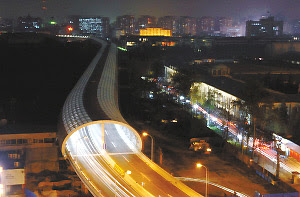
The city of Beijing just opened an elevated tunnel. The goal is to ease traffic that snarls up as cars try to move between the West second and third ring road. This sounds perfectly normal, and much like the bypass any other city might build.

The difference is that this tunnel passes over the Beijing City Zoo, and it's supposedly soundproofed to protect the animals. I haven't been to the zoo. Scot hasn't been to this one, either, but he says that zoos in China are the most appalling he's seen. This particular zoo is home to China's premier panda exhibit, however, so I hope that the high profile keeps them honest. I'm curious whether the efforts to soundproof the tunnel will pay off, but I wonder more about what the animals went through while they were building the damn thing.


Friday, November 16, 2007

It sure looks like the world is ending.

This Global Incident Map is pretty amazing, but what's actually shocking to me is how closely it resembles CNN or Fox News or any other media source.

Tuesday, November 13, 2007

Who IS that masked laowai?

Mask Week is a not-a-protest being organized by some guys on the That's Beijing forums.


The idea is simple.
1. Buy a mask. (The best one possible to protect you from air pollutants) Still, simple cloth masks, although not very effective can still raise awareness. You can buy them cheaply in local pharmacies, supermarkets and so on.
2. From the time you wake up on the 17th to the time you go to bed on the 24th wear a mask whenever you go outside. Just live your daily life but when you step out the door, wear a mask. (Yes we realize that indoor air pollution is more dangerous because it is concentrated but this is aiming at outdoor air pollution.)

...

Mask Week's goal is to promote dialogue about air pollution's dangers and its consequences. For many people who have grown up with air pollution, having gray skies and smog is "just the way it is." Many say they are used to it and others simply say there is nothing that can be done. Meanwhile, babies are being born defective, cancer is rising, and people are dying prematurely because of at least in part from air pollution. Mask Week is to get people moving. To stop people from accepting air pollution as the way things have to be. Talking to others is an important first step to change. And this is what Mask Week seeks to do. Get people talking about solutions so that more and more people can live happy and healthy lives.


I, for one, will be wearing a cheap, ineffective paper mask, starting on 11/17 ('yao yao yao qi', which also means 'want want want air').

Monday, November 12, 2007

Buy Prada, support the Motherland!


The whole video is an interesting look at Xinjiang, China's western-most, largest, and maybe most resource-rich province. I knew that China had been sending ethnic Han workers out to the province's cities to 'dilute' the Muslim influence and try to bring the population more into line with the rest of the country, and this documentary touches on the issue.

My favorite part, though, is the swearing-in ceremony of new Communist Party members in the last minute or so. They swear to fight for communism with all their might, at the same time wearing imported clothing in Western styles.

Also, while looking for work today, I found a middle school searching for a business teacher. "Remember, kids. China's a communist country. Buy Prada, support the motherland!"

Tuesday, November 6, 2007

I can't see the ground 14 floors down.

This is from one of my favorite China bloggers, Imagethief:


Proving that there is no idea so unoriginal that it can't be rejuvenated by making it bigger, Beijing has announced plans for a colossal Ferris wheel. This, it is claimed, will be larger than both the famous London Eye (destroyed by the Fantastic Four in a recent movie, I recall) and the Singapore Flyer, which Imagethief has often fantasized seeing break free from its moorings and roll across the straits to Batam.

From 208 meters above Chaoyang Park you are guaranteed a spectacular view of, well, Chaoyang Park. But to tantalize you, the China Daily has included this 3D rendering of the proposed wheel of joy pictured before a suspiciously clear sky:


In fact, it's so suspiciously clear that I did a little digging, and sure enough, have found this other, well hidden rendering that depicts the wheel in actual Beijing conditions:


Fun!


From my own perspective (literally, as I can see that spot from my window) I imagine this will be quite an eyesore. Chaoyang Park, and the neighboring embassy district, are the one wooded, green part of town for a fair distance. I've joked about this before, but I'll do it again. Chaoyang Park is the largest park in Asia (I mistakenly told my dad the world.) I live on Chaoyang Park West Road. Central Park West in NYC is abbreviated CPW. I live on Beijing's CPW. This is relevant now as a comparison. Can you imagine the uproar if all of the New Yorkers who paid top dollar for a park view apartment were going to get to look at a huge, garishly-lit, carnival ride instead of their sanity-preserving trees? And believe me, it will be garishly lit.

Thursday, October 25, 2007

Toothless sabercat.

It's United Nations Day. Did you remember to send your loved ones a strongly worded letter?

A day or so late, but ah well.

Thursday, October 18, 2007

Evolutionary laws in language

From a press release from MIT:


Predicting the future of the past tense
Mathematicians apply evolutionary models to language

October 15, 2007

Verbs evolve and homogenize at a rate inversely proportional to their prevalence in the English language, according to a formula developed by MIT and Harvard University mathematicians who've invoked evolutionary principles to study our language over the past 1,200 years.

The team, which reported their findings in the Oct. 11 issue of Nature, conceives of linguistic development as an essentially evolutionary scheme. Just as genes and organisms undergo natural selection, words--specifically, irregular verbs that do not take an "-ed" ending in the past tense--are subject to powerful pressure to "regularize" as the language develops.

"Mathematical analysis of this linguistic evolution reveals that irregular verb conjugations behave in an extremely regular way - one that can yield predictions and insights into the future stages of a verb's evolutionary trajectory," says Erez Lieberman, a graduate student in the Harvard-MIT Division of Health Sciences and Technology and in Harvard's School of Engineering and Applied Sciences. "We measured something no one really thought could be measured, and got a striking and beautiful result."

"We're really on the front lines of developing the mathematical tools to study evolutionary dynamics," says Jean-Baptiste Michel, a graduate student at Harvard Medical School. "Before, language was considered too messy and difficult a system for mathematical study, but now we're able to successfully quantify an aspect of how language changes and develops."

Lieberman, Michel, and colleagues built upon previous study of seven competing rules for verb conjugation in Old English, six of which have gradually faded from use over time. They found that the one surviving rule, which adds an "-ed" suffix to simple past and past-participle forms, contributes to the evolutionary decay of irregular English verbs according to a specific mathematical function: It regularizes them at a rate that is inversely proportional to the square root of their usage frequency.

In other words, a verb used 100 times less frequently will evolve 10 times as fast.

To develop this formula, the researchers tracked the status of 177 irregular verbs in Old English through linguistic changes in Middle English and then modern English. Of these 177 verbs that were irregular 1,200 years ago, 145 stayed irregular in Middle English and just 98 remain irregular today, following the regularization over the centuries of such verbs as help, laugh, reach, walk, and work.

The group computed the "half-lives" of the surviving irregular verbs to predict how long they will take to regularize. The most common ones, such as "be" and "think," have such long half-lives (38,800 years and 14,400 years, respectively) that they will effectively never become regular. Irregular verbs with lower frequencies of use--such as "shrive" and "smite," with half-lives of 300 and 700 years, respectively - are much more likely to succumb to regularization.

They project that the next word to regularize will likely be "wed."

"Now may be your last chance to be a 'newly wed'," they quip in the Nature paper. "The married couples of the future can only hope for 'wedded' bliss."

Extant irregular verbs represent the vestiges of long-abandoned rules of conjugation; new verbs entering English, such as "google," are universally regular. Although fewer than 3 percent of modern English verbs are irregular, this number includes the 10 most common verbs: be, have, do, go, say, can, will, see, take, and get. The researchers expect that some 15 of the 98 modern irregular verbs they studied--although likely none of these top 10--will regularize in the next 500 years.

Their Nature paper makes a quantitative, astonishingly precise description of something linguists have suspected for a long time: The most frequently used irregular verbs are repeated so often that they are unlikely to ever go extinct.

"Irregular verbs are fossils that reveal how linguistic rules, and perhaps social rules, are born and die," Michel says.

"If you apply the right mathematical structure to your data, you find that the math also organizes your thinking about the entire process," says Lieberman, whose unorthodox projects as a graduate student have ranged from genomics to bioastronautics. "The data hasn't changed, but suddenly you're able to make powerful predictions about the future."

Lieberman and Michel's co-authors on the Nature paper are from Harvard. The work was sponsored by the John Templeton Foundation, the National Science Foundation, and the National Institutes of Health.

----

It's interesting to me that the selection that occurs here for for simplicity. In nature, natural selection in higher organisms tends towards more complex beings. Those that have extra genes and an efficient way of controlling them do pretty well. The energy expended in copying the genes when cells divide is the only wastage, but when the gene is needed it turns on and saves the day. In simpler organisms, like E. coli, the process of replicating that DNA is the most energy intensive thing the organism will ever do, and there's a tendency towards brevity of genomic information.

Language is one of modern humans' most fundamental, energy intensive endeavors. We talk all of the time, and write and read when we're not talking. We tend towards simplicity of language because it's easier, it takes less work. Txt msg spk makes sense for someone with more information to convey and process than time or intelligence to do so. So as our language evolves it cuts out the extra steps, the extra rules, the extra genes, tending towards homogeneity rather than diversity. In nature, this only works in quickly multiplying, highly mutable life forms- organisms that die quickly in the best of situations and whose offspring may be very different from themselves. If you're a species like a mammal and you're non-diverse then you're extremely vulnerable to shocks.

I'm not sure whether a language can be vulnerable to environmental changes- there's no such thing as a temperature spike or a food shortage in literature. Maybe a simple language is a language that is more quickly taken up by others, and a virus analogy would be better. A successful virus, or parasite of any kind, often doesn't harm its host in an evident way. It piggybacks on the organism's processes, but might not drain enough energy to do real harm. These viruses multiply easily and spread from host to host without burning their homes down. Maybe a successful language is one that infects a host without putting undue demands on its system.

Counterfeit $2.64 bills

When I tried to pay for my lunch on Saturday, the restaurant I frequent wouldn't take the 20RMB ($2.64) note I handed them. Actually, I didn't even finish handing the bill over before they rejected it; it was a pretty obvious counterfeit. I had gotten the bill the night before while out at a fancy lounge. The lounge has two girls sitting at a desk with a UV lamp and a bright visible spectrum lamp checking incoming bills, so it's not really possible that the money I was given in change came from the till by accident. Somewhere between the till and my hands the fake 20 had to have been switched in and the real one pocketed, so that means it was probably the waitress. It was dark and I was drinking, and I don't usually check bills under 50RMB anyway, even though they apparently even make fake 5RMB notes. Fortunately I had enough coins and small bills at the restaurant to pay for lunch, otherwise I would have had to go to a bank and come back. They know me there, so it probably would have been fine, but it was irritating.

I've decided to keep the counterfeit note rather than to try to just spend it. The typical attitude towards a fake bill here is one of annoyance. It's not usually a real loss, you just have to keep trying to pass it until someone takes it, then it's their problem.

I had hoped to write something here about statistics on counterfeiting in China versus the rest of the world, but no one seems to have the numbers. There are reports in newspapers of huge sting operations seizing millions of dollars worth of fake Chinese currency, but that's all released by the Chinese government in official Chinese government-owned newspapers, and there doesn't seem to be anything recently. The general consensus on the street is that with the rise of cheap printing technology, counterfeiting is worse here than ever.

Tuesday, October 16, 2007

Extinguishing the light at the end of the tunnel

Last week, after returning to Beijing from my vacation (chronicled here in pictures, but perhaps never to be typed up in the blog), I was ecstatic to discover that in addition to opening a new subway line, the price of tickets had actually been lowered, from 3RMB to 2. I was gleeful, to say the least.

My glee was poorly thought out, as such emotions tend to be. In addition to the new line servicing its own area, it brought a huge increase to the number of people transferring to and riding the 2 existing lines. A China Daily article quotes city officials who say that the passenger volume has increased by 46% since the opening of the new line, "an immediate positive impact." Of course this increase in passenger load has made morning commutes almost unbearable, and even Sunday afternoon rides unpalatable.

The city announced earlier in the year that it will bring 264 new subway cars into service and cut waiting times for every line in order to make public transit more comfortable and appealing. They also seem to recognize that more lines are needed to make the subway a good choice for most commuters. They plan 4 more lines by 2010, bringing the total to 7, and a total of 19 lines covering 560 km by 2020, making the network the largest in the world. Of course, reducing the fare by 33% means reducing their revenues by nearly the same amount, costing the government an estimated $130 million a year on top of existing subsidies.

Meanwhile, as long as the experience underground is miserable and crowded, more people will be driven towards the great Chinese dream of the decade- car ownership. People who can afford a car are not going to be won over by a 1RMB price decrease. Cars are partly status symbols, but they're also (delusionally) perceived as convenient and comfortable compared to other forms of transportation in the city. To paraphrase a poster in a Beijing expat message board commenting on the price drop, the city won't persuade a single driver to switch over, they lost a third of their revenue, and they made the subway a living hell. Brilliant.

I'm also going to steal a potential solution from that same forum thread and expand on it a little. Don't decrease the fare, increase it. Make it 10RMB a ride, a 400% increase from the new price, and a luxury experience. Provide a hot cup of soy milk and a fried dough stick in the morning, an evening paper on the way home, and make the ride comfortable. If they want to reduce pollution and improve traffic they need to bring rich people down out of their cars, not take poor people off of their bikes and out of the buses. It shouldn't be too hard a sell. Drivers sit in traffic that's getting worse by the day. Surely reading a newspaper in an air conditioned, well-appointed subway carriage as they're whisked to work is a better solution. The poor people were doing fine with their buses and their bikes until the cars arrived and tangled up traffic. A huge price increase doesn't seem to be helping the poor people, but I think in the grand scheme it is.

Tuesday, September 11, 2007

River crabs

I'm blatantly stealing this post from imagethief, a highly regarded China blogger I read. He links to Rebecca MacKinnon's blog and quotes this:


In China these days, if your website gets blocked, your blog-hosting service takes down a politically edgy post you wrote, or your ISP deletes your site completely, you say: "I've been harmonized." The word for harmony, harmonized, or harmonious (all the same word in Chinese) is pronounced "he xie" in Chinese and is written like this: 和谐. For those without Chinese fonts on their browser.

However, there's a slight problem, which is that since this phrase is so often used sarcastically on Chinese blogs and forums, it has been flagged as a sensitive keyword by many of the blog and forum hosting platforms, increasing the chances that a post using this phrase could itself get "harmonized." So bloggers and chatroom denizens have switched the characters to another phrase, 河蟹, also pronounced "he xie" (with slightly different tonation) which means "river crab".

Thus, when bloggers seem to be writing nonsensically about "river crab," they're actually talking about censorship.


Imagethief also notes that Chinese is an excellent language for puns.

Convictions for Sale

An article in the NYT and the IHT today discusses American investment in Chinese companies developing sophisticated surveillance equipment. Because the companies do their technology development in China they're exempt from US export controls, but they're still welcome to take funding from US investors and hedge funds. So, with a $110 million loan from the Citadel group, a Chinese company called China Security and Surveillance Technology is buying up all of its competitors, celebrating each acquisition with a banquet for potential acquisitions and public officials. From the article.


“When they come, they hear central government officials endorsing us, they hear bankers endorsing us or supporting us, it gives us credibility,” Mr. Yap said. “It’s a lot of drinking, it’s like a wedding banquet.”


While that's a very Chinese way of doing business, the idea of one company buying out all of its competition with money it receives from the US, all the while cozying up to the Chinese government and in effect bribing its remaining competitors, is sickening and scary. In fact the Minister of Public Security is now director of the company, meaning the number of degrees of separation between the US investors and the Chinese government is frighteningly small. China just passed a law restricting monopolies, and The China Daily recently condemned monopolies as bad for the nation, calling them the major obstacle in the promotion of social interests. I don't know the full story behind this company, but a government minister is in control, the company is consolidating the industry, the competition's bosses are being wined and dined, and unrestricted money is flowing in from Wall Street.


The equipment China Security and Surveillance Technology develops is ostensibly for public safety and crime reduction. Surveillance companies in China point out that the UK has a more sophisticated and extensive camera network already in place, and Manhattan is setting up a similar system, so they argue that we're in no location to criticize. Representative Tom Lantos, chairman of the House Foreign Affairs Committee, argues that surveillance in China is not the same as surveillance in the West, as China is a one-party state with little to check its actions. Mr. Lantos also plans to investigate “the cooperation of American companies in the Chinese police state.”

I don't like China's government, and I don't like its restrictions on its people, but I'm simply appalled by the idea of Americans directly supporting its worst characteristics. Institutions like the NYT are good at getting attention, though, for example when the UAE wanted to buy a controlling interest in our ports. Hopefully I'm not the only member of the American public who feels this way, and the attention will lead to support for Mr. Lantos and his investigation.

Monday, September 3, 2007

Writing headlines is harder than writing post titles.

With the 2008 Olympics fast approaching, and China’s ambitiously green Beijing still invisible through the smog, the government is exploring radical options to ensure that the environment doesn’t spoil their pageant.

The city recently tested a partial ban on private cars, taking an estimated one million vehicles off the road for 4 days. Beijing’s streets were noticeably less gridlocked, but the success of the experiment in clearing the air is questionable. On August 20th, the final day of the ban, the city’s air pollution level remained unchanged. Yu Xiaoyuan, environmental director of the Beijing Olympic Organizing committee, declared the experiment a success: “If we had not had the traffic controls we could not have maintained this level because the temperature and humidity were very high. So we can see the restrictions worked.” Despite Mr. Xiaoyuan’s enthusiasm, at the time of writing, air quality data for August 20th was unavailable on China’s State Environmental Protection Administration website, the only day this year without statistics provided.

A ban on cars is only one of the drastic measures under consideration. China has ramped up its weather control program in order to prevent Beijing’s frequent summer downpours from disrupting the event, and perhaps to use nighttime showers to clear the air of dust and pollutants. The government has trained and recruited over 37,000 peasants to operate Mao-era artillery, firing exploding shells of silver iodide into clouds to accelerate their growth and induce rain. The weather controllers hope to intercept any cloud formations heading towards the city, dumping any rain safely out of sight of the Olympic dignitaries and press.

These experiments are nothing new- party bosses have long addressed symptoms of environmental problems rather than their cause.

Mao proposed in 1958 to connect the flood-prone Yangtze with the silt-choked Yellow River. In Mao’s vision, currently under construction, man-made channels stretch 1200 km to bring water to the parched North. However, environmentalists, including the State Environmental Protection Agency, doubt the plan’s potential. They propose water conservation as the solution to shortages in northern China, blaming artificially low water prices that encourage waste and make conservation technologies less economical. Environmentalists are also concerned that the plan could dry up the Yangtze River in 30 years.

The aridity of the North is a significant problem for China. Overgrazing, drought, and deforestation expand the Gobi desert by 950 square miles a year, and have led to sandstorms that reach Tokyo and are detectable even in the United States. China is responding by planting the Great Green Wall, a network of tree belts covering 9 million acres, to act as a windbreak and eventually to reclaim the desert. While hopes are high that this wall, the largest ecological project in history, will be a success, China continues to cut down 25 million trees a year for chopsticks alone.

The future aside, addressing the symptoms of environmental problems may be just the short-term fix that Olympic planners need. If a car ban and weather control are insufficient, China is reserving the option of pushing the big red button- shutting down all industry in Beijing. However, even bringing the city to a screeching halt may not work. For years Beijing has been coercing its heavy industry to relocate, but factories have settled nearby in the welcoming Hebei province, where summer wind conditions blow their pollution right back over Beijing.

This puts China’s government in the unenviable position of deciding between wielding their enormous influence and paralyzing the country’s industrial heartland or allowing Olympic athletes to arrive in Beijing wearing the activated charcoal masks issued by many teams. With the amount of international credibility China has staked on the games, it seems likely that some sort of shutdown will occur. What remains to be seen is how an increasingly liberalized Chinese market will react to command economy restrictions on a scale not used in years.

Wednesday, August 22, 2007

The Bermuda Triangle moved south.

So I don't follow Venezuela news very closely, just the latest craziness from Chavez.


CARACAS, Venezuela (AFP): President Hugo Chavez Sunday announced that Venezuela's official time will be put ahead by half an hour starting January 1, and its first-ever offshore oil rig will start pumping before the year is out.


I wondered what the justification would be. Maybe something about conforming to time zones set up by capitalist, imperialist countries while Venezuela straddled two of them? Maybe something about a compromise, single time zone for the whole country to help bring it together?


"Its about the metabolic effect, where the human brain is conditioned by sunlight," Chavez said in a rambling, seven hour discussion on his radio show "Alo, Presidente"


When I was there the television appearances would last a few hours, which was bad enough as it interrupted any TV you might want to watch that evening, but SEVEN HOURS? That's a whole workday. He's extended his own regime indefinitely and consolidated all federal power into his hands in the name of democracy. How does the guy have time to govern a country that he single-handedly controls? I feel like the power grabbing can be explained by a hunger for influence that I can sympathize with, and seems more normal, less diseased, than the thought process that makes him believe his countrymen want to listen to him talk for 7 hours in a day. He realizes that his biggest supporters are the country's poorest citizens and probably have to, you know, work, right? But I guess with the new 6-hour maximum workday they'll have more time to spend listening to him and less to waste on diversifying and strengthening the national economy in preparation for the inevitable oil decline.